Silos
Menu

Product

Product overviewThe panelNeeds youAgentsTasksAutomationsSilosEnginesOpen source

Solutions

Solutions overviewCoding agentsA small businessSupportFinance

Resources

Compared with terminal tabs

Company

About

Docs

All the docsInstall

Product › Engines

The real Claude Code, not a wrapper.

Silos runs over the engine you already use. Claude Code is the default, the unmodified CLI on your own subscription; OpenCode is the optional second engine, for any provider it supports. Both work side by side in one fleet.

The CLI you know, in your browser, on your subscription

The real console runs the claude command from your PATH in a tmux session and shows its terminal in your browser. The chat view runs each turn through the Claude Agent SDK, pointed at that same binary.

Silos never patches or forks it. It adds the mission, the agent's identity, its territory and its skills through what Claude Code documents: flags, settings files, hooks and plugins. Signing in is Claude's own claude auth login.

Real consoleChat
> export this month's invoices as CSV

● Read  src/invoices/template.ts
● Write src/invoices/export.ts
● Bash  npm test -- invoices
  12 passed

Done. One row per invoice, credit notes as
negative rows. Branch feat/invoice-export.

The unmodified CLI, in your browser.
The real terminal, next to a switch to chat.

OpenCode, for any provider it supports

Install the opencode binary and choose OpenCode under Harness when you create an agent. It can run on a key for a provider OpenCode already knows, an Anthropic-compatible endpoint, or OpenCode's own login.

Home, Needs you, tasks, automations, the Vault and the territory stay the same. Silos opens every OpenCode database read-only, and a permission request from OpenCode becomes a Needs you row you can answer.

Builder

the same agent, the engine you choose

Claude Codeyour subscription
OpenCodeany provider, your key
One agent, over Claude Code or OpenCode.

A model and an account per conversation

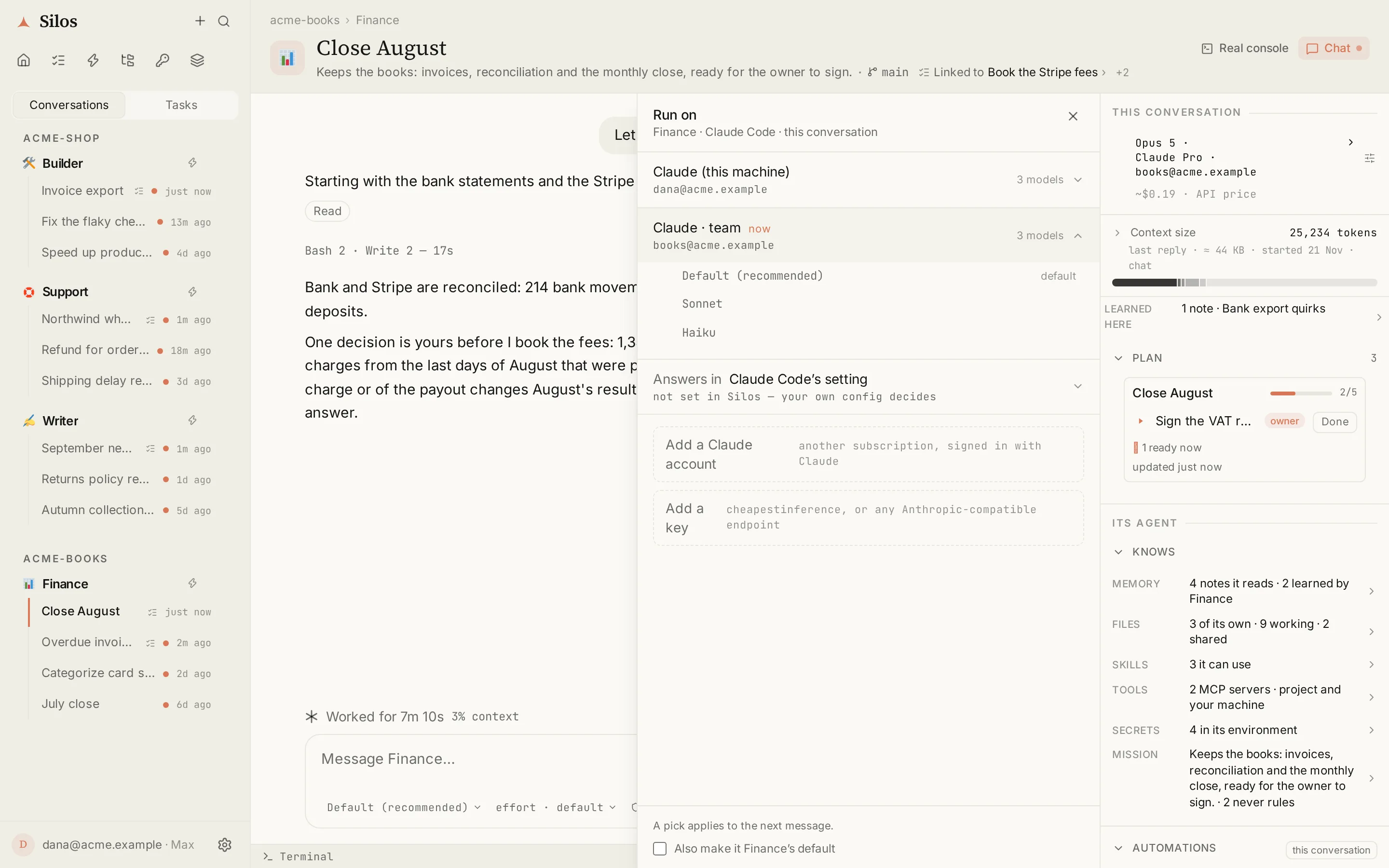
«Run on» lists every model the agent's engine can run, grouped by the account or key that runs it. A pick is pinned to that conversation, and "Also make it <agent>'s default" saves it for the agent.

Keep several Claude accounts on one machine, each signed in with Claude's own login. A fallback provider takes over at a turn boundary when the primary hits its usage limit.

The Run on panel of one conversation: two Claude accounts, the one in use marked, and the models each offers.
Run on: two Claude accounts and the models each offers. Demo data.

Engines in Silos compared with one CLI per terminal

One CLI per terminalSilos
The engine itselfUnmodifiedUnmodified
Switching accountsLog out and inPick one per conversation
Another providerAnother tool to learnOpenCode, same screens
One quick sessionFine as it isIt shows up here too

Questions

Do I need an API key?

No. Claude Code runs on the Claude subscription you sign in with. Silos reminds you that a subscription is for your own use: if the install works for someone else's business, use an API key.

Does it change how Claude Code works?

No. Silos runs the claude on your PATH and uses only its documented flags, settings, hooks, CLAUDE.md, skills and memory. It never handles your Claude credentials.

Which Claude Code version do I need?

Silos' SDK is paired with one Claude Code release, and that is the minimum. An older claude is refused with claude update as the fix; a newer one keeps running, with a line saying it is not yet verified.

What do I lose on OpenCode?

Things read from records only Claude Code writes: the «Started with» breakdown, «% context», the plan-mode proposal and output styles. Usage says "not measured on OpenCode" instead of inventing tokens.

Can I switch an agent's engine later?

No. The harness is chosen when you create the agent; its settings show it but do not change it.

Bring the engine you use

Install Silos beside Claude Code, and add OpenCode only if you want another provider.